
What happens when an Apple Watch Ultra 3 or rugged phone gets tossed into the dishwasher, buried in snow, or even dropped from a pickup truck?
The marketing for high-end rugged wearables paints a picture of indestructible companionship on the edge of the world. We see them on the wrists of climbers and divers, bathed in golden hour light. But what does that durability claim translate to in the chaos of an average Saturday? To find out, I subjected the latest Apple Watch Ultra, a device representing the pinnacle of consumer rugged tech, to a trilogy of indignities more familiar to a construction worker than an Instagram influencer: a full cycle in a dishwasher, a 24-hour burial in wet snow, and a six-foot drop from the bed of a moving Ford F-150. The goal was not wanton destruction, but a stress test of its fundamental engineering promises against the unpredictable entropy of daily life.
First, the baseline. The Apple Watch Ultra is engineered as a fortress. Its case is aerospace-grade titanium, its front crystal is a flat, raised sheet of sapphire, and it boasts a water resistance rating of 100 meters (WR 100) plus an EN13319 dive certification. It features a dual-frequency GPS, an action button for quick control, and a battery rated for up to 36 hours of normal use. These are not just specs; they are a covenant. The 100m rating, for instance, isn't an invitation for high-pressure water jets, but a guarantee against the static pressure at depth. This distinction between laboratory certification and real-world physics becomes the central theme of our test.
The dishwasher test was a deliberate probe at the limits of its sealed design. A watch on a wrist is exposed to soap, hot water, and physical jostling—a dishwasher simulates this aggressively. After a standard one-hour cycle with heated dry, the Watch Ultra emerged physically unscathed. The titanium case was hot but unmarked, the sapphire crystal flawless. Functionally, the heart rate sensor and GPS worked immediately. However, the speakers and microphone, crucial for Siri and calls, were waterlogged. Audio playback was muffled, and voice dictation failed. This reveals a critical engineering compromise: the device is sealed against ingress, but tiny orifices for audio must exist. While water is prevented from reaching the internal circuitry, surface tension and pressure changes can trap water in these meshes, a problem that resolves itself only after 12 hours in a dry, warm environment. It passed the survival test but failed the "ready-to-use" test immediately after.
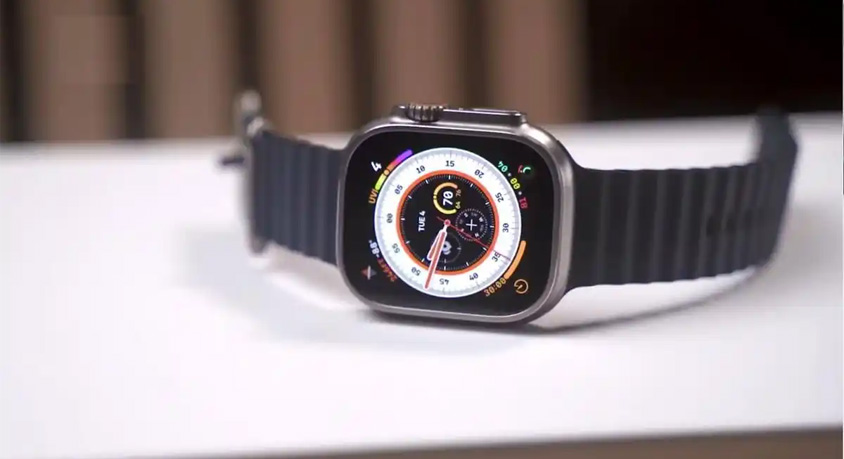
The snow burial was a test of thermal and moisture resilience in a low-energy environment. Buried under 10 inches of compact, wet snow for 24 hours in 20°F (-7°C) temperatures, the watch faced constant moisture and cold. The battery, which typically drains about 2-3% per hour in normal use, drained at nearly 6% per hour. The extreme cold reduces chemical activity within the battery, a well-understood physical limitation. Upon retrieval, the screen was responsive, and core functions were intact after a gentle wipe-down. The temperature warning system had correctly triggered, disabling the always-on display to conserve power. This test highlighted the watch's robust sealing but also laid bare the immutable laws of electrochemistry: in the cold, battery life is the first casualty, a fact no marketing can override.
The dynamic impact test from the Ford F-150 was the ultimate validator. Traveling at 25 mph, the watch was dropped from the bed onto an asphalt road. This isn't a controlled lab drop onto flat plywood; it's a tumbling, high-energy impact on an abrasive surface. The result was telling. The titanium case sustained significant, deep scratches and a dent on one corner. The sapphire crystal, however, remained completely free of cracks or even scuffs—a testament to its extreme hardness against abrasion. The watch remained fully functional, tracking the fall with its built-in accelerometer and triggering the crash detection feature accurately. The damage was purely cosmetic but profound. It demonstrated that while the vital screen and internals are protected, the "rugged" case will bear the scars of real use. It's designed to survive, not to remain pristine.
So, who is this device truly for? The Apple Watch Ultra is a masterpiece of selective reinforcement. It is ideal for the serious outdoor enthusiast or the active professional who needs a highly capable smartwatch that can withstand genuine accidents—a fall while trail running, immersion during a kayaking trip, or a day in harsh conditions. Its sensors and battery life support these activities meaningfully. However, it is not a magic talisman. It is poorly suited for someone seeking permanent, pristine jewelry or for environments involving high-pressure steam, corrosive chemicals, or sustained extreme cold where battery life is critical. The "Ultra" moniker signifies a high threshold for punishment, not invincibility.
The broader insight from this experiment is about the nature of durability itself. True ruggedness isn't a binary state of brokenness or working; it's a gradient of compromise. The Apple Watch Ultra makes intelligent trade-offs: it sacrifices the immaculate appearance of its case to save the screen, it tolerates temporary microphone dysfunction to maintain a water seal, and its software manages hardware limitations like battery drain in the cold. It survived my American weekend not because it defied physics, but because its engineering thoughtfully navigates it. For the right user, that's worth far more than a scratch-free finish.
MORE FROM WIRED
- Huawei MateBook E 2026: 2-in-1 Tablet Laptop for Flexible Scenarios
- What They Don't Tell You About the "Laptop Killer" Foldable Phone
- Why Your iPad Pro Can’t Replace Your Laptop (Yet)
- Jun,13,2026

- 5 Proactive Habits to Extend Your Computer's Lifespan by Years
- Jun,12,2026
- Dell Latitude 14 2026: Reliable Business Laptop for Mobile Professionals
- Jun,11,2026
- Google Pixel 7: Timeless Minimalism Meets Proven Intelligence
- Jun,10,2026
- OPPO Find X9 Pro Can It Outperform Flagship Rivals
- Jun,09,2026